Introduction
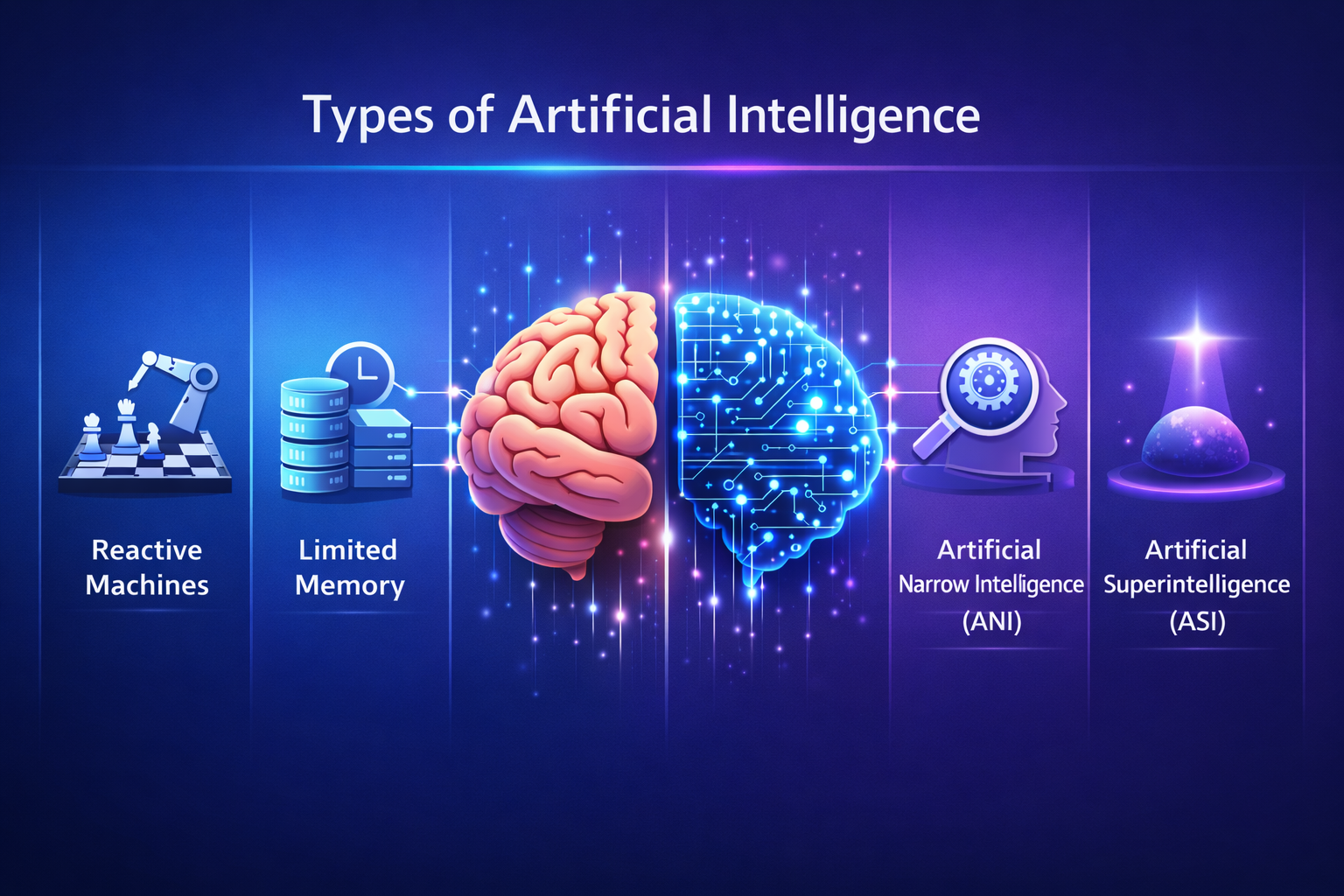
Whenever we talk about artificial intelligence (AI), we tend to think that AI is of only one type, but this is not true. AI comes in different types, each with different functions and capabilities. So, in this article, we will learn about the different types of artificial intelligence and see what these types are and what they can do.
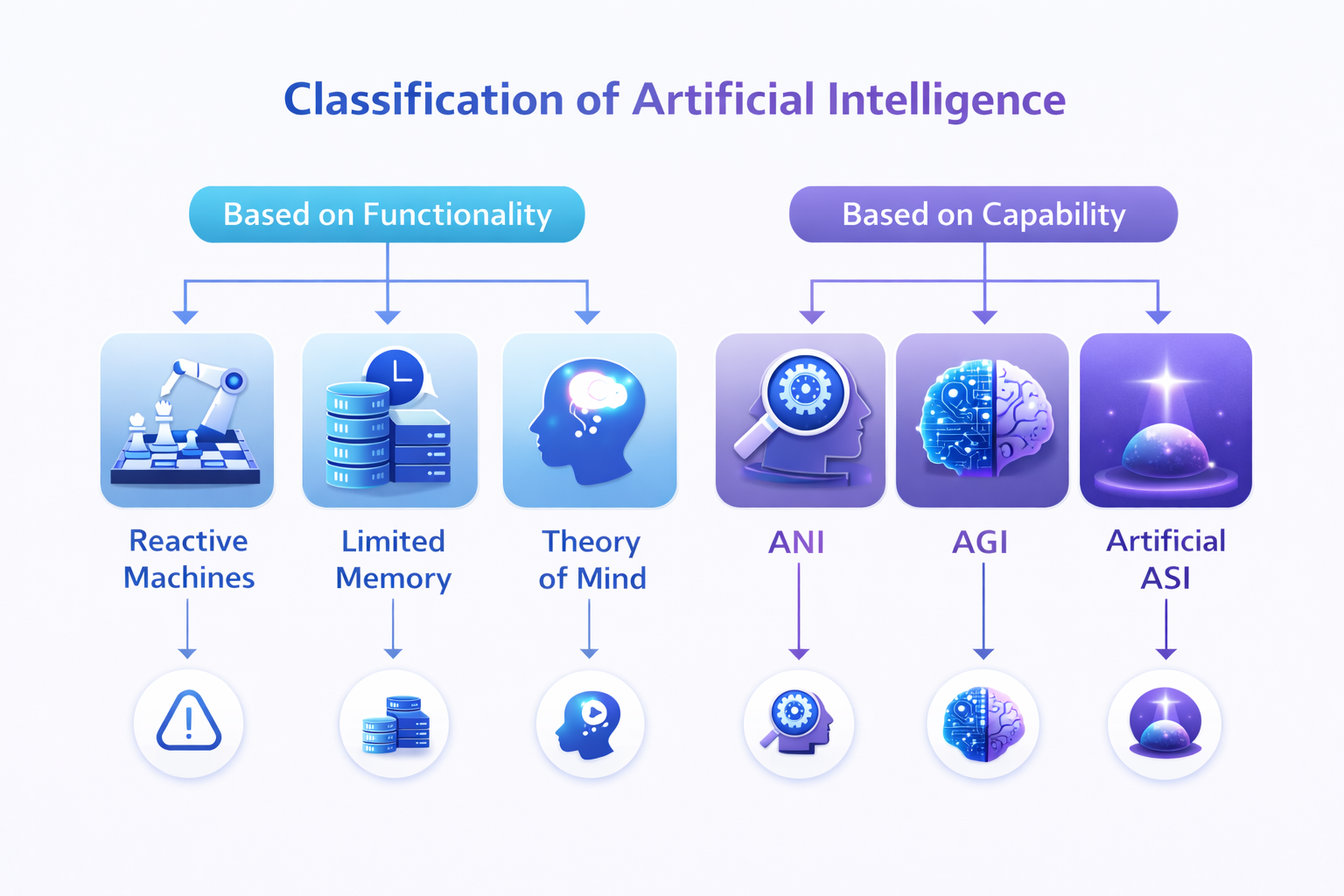
classification of artificial intelligence
To understand Artificial Intelligence, it can be divided into 2 parts.
1. Based on functionality
2. Based on capacity
This will tell us what Artificial Intelligence can do today and what it can be called in the future.
Part 1: Types of Artificial Intelligence based on functionality
1.reactive machine: AI artificial intelligence only reacts
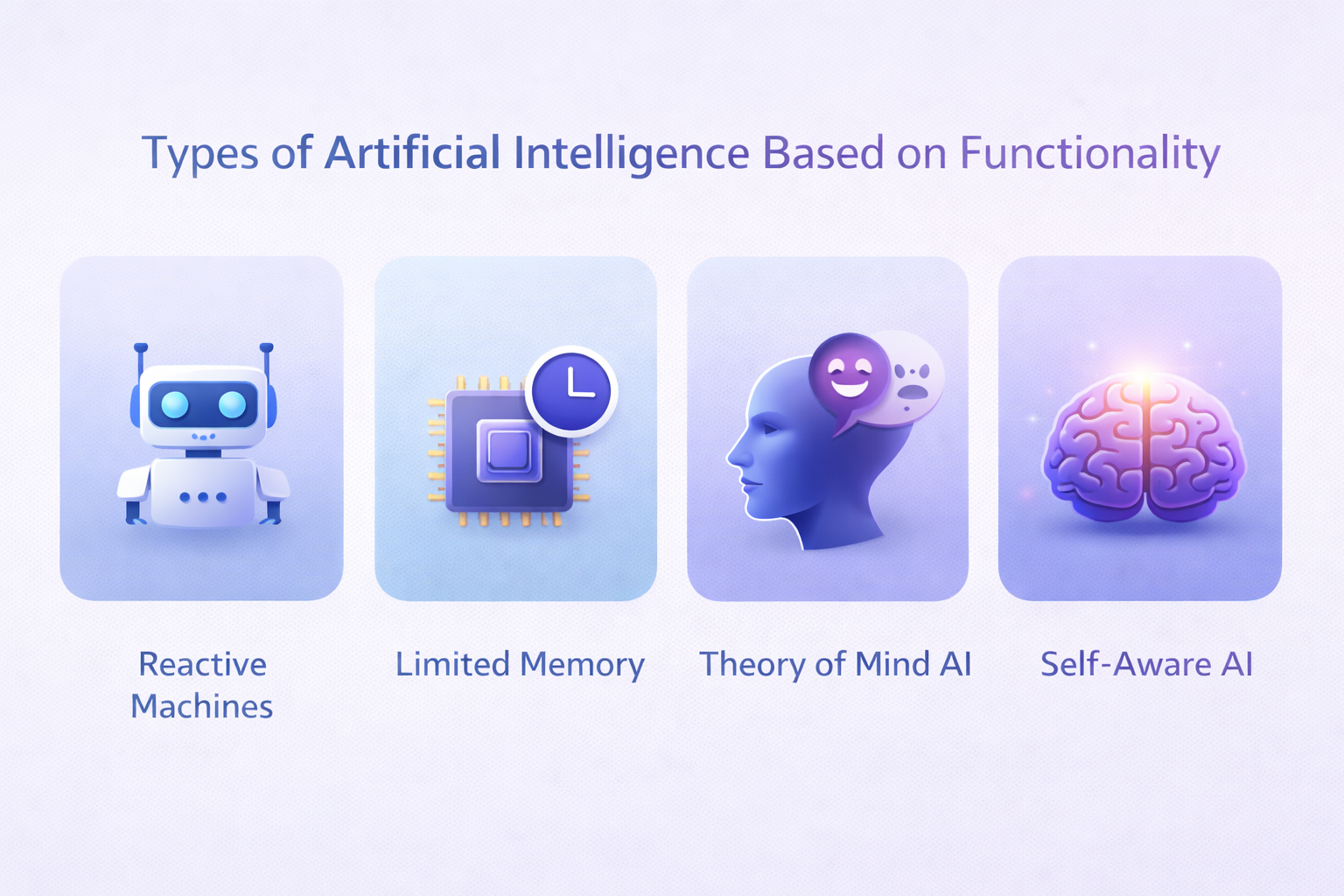
This is the type of artificial intelligence in which:
- It reacts only to the given current input.
- This artificial intelligence does not store past memory or data.
- It does not make predictions about the future.
Example
- Chess computer (IBM Deep Blue)
They respond by looking at the chessboard. They react according to the move the opponent makes. However, they don’t learn anything from previous matches because this artificial intelligence doesn’t store data.
2. Limited memory: can only remember a little.
90% of the AI we use today falls under this category.
This AI has:
- Has short-term memory
- Makes decisions using past data
Example
Self-driving cars
They drive while keeping in mind the speed, traffic, and signals.
Recommendation systems
When we are on a social media platform (e.g., YouTube, Instagram), it suggests videos and content based on what we watch.
This AI learns from past data, but it cannot remember things in the long term. it only has short-term memory.
3. Theory of Mind: which attempts to understand emotions.
This AI is currently in the research stage.
What is Goal?
- Understanding human emotions, intentions, and behavior
- Improving social interaction
Possible future examples:
- Emotional support robots
- AI therapists
- Smart autonomous vehicles that can predict human intent
Note:
Tools like ChatGPT simulate empathy, but they don’t actually feel it.
4. Self-aware: one who is aware of their own existence.
This AI is currently a part of science fiction.
If it is ever created:
- It will have its own consciousness.
- It will have its own judgments and desires.
- It will be able to understand moral dilemmas.
According to scientists,
creating truly self-aware AI is still a huge technical and philosophical challenge.
Part 2: Types of AI based on capabilities
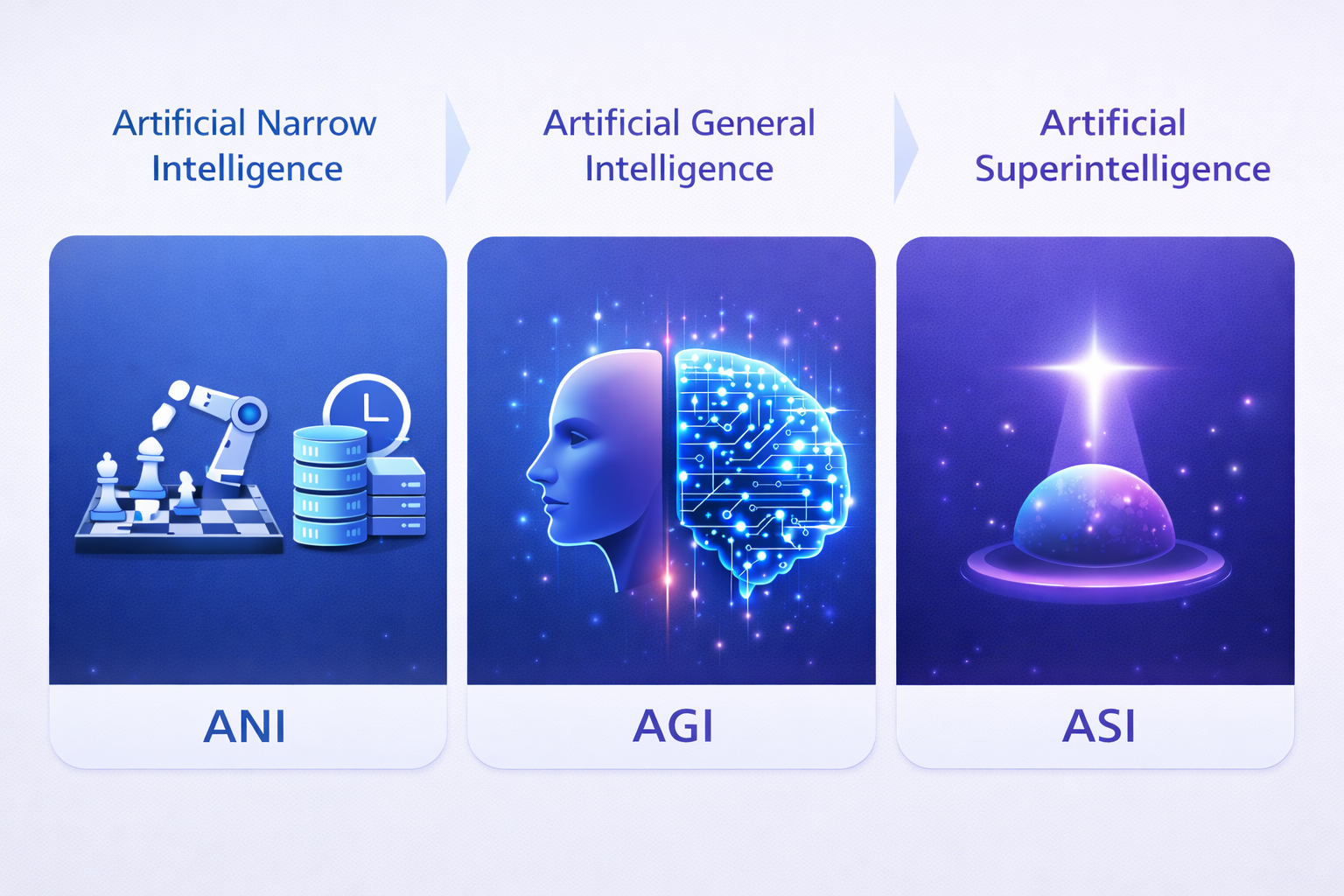
1. Artificial Narrow Intelligence (ANI) – Today’s Real AI
Also known as Weak Artificial Intelligence
What can do ANI ?
- This AI only performs a specific task that it is instructed to do.
- It does not do anything outside of its scope.
Examples
- ChatGPT (generate text)
- Netflix recommendations
- face recognition
- voice assistants
All the artificial intelligence in the world today is almost ANI
2. Artificial General Intelligence (AGI) – Human-Level AI
AGI is an artificial intelligence that will be able to perform every task like a human.
- Knowledge learned in one place can be applied in another place.
- Give me a new problem, and I can find a solution.
- It uses context, logic, and reasoning.
Status:
- It doesn’t exist yet.
- Experts say it could take 5-20 years.
3. Artificial Superintelligence (ASI) – even smarter than humans.
There is such a theoretical concept where:
- It will be more intelligent than humans.
- It will be able to improve itself.
- It will be able to predict global events.
This is also the stage where the risk is highest if the goals are not aligned with human goals.
New Wave: Generative AI and Agentic AI
Today, AI is not limited to just providing answers
Generative AI
- It creates new content (text, images, code).
- Examples: ChatGPT, Gemini
Agentic AI
- It doesn’t just provide answers, it also performs tasks
- Booking tickets
- Automating tasks
Conclusion
Artificial Intelligence is not a single technology, but an entire ecosystem of different levels and forms that are shaping our thinking, work and future. Today we are in the phase of Weak AI (ANI) which is making daily life easier, and in the future advanced forms like AGI and ASI can transform the world even more, but one thing is clear – the future of AI will not be in the hands of machines, but in the hands of human decisions. Therefore, instead of being afraid of AI, it is important to understand AI and grow with it, because the future will belong to those who do not blindly follow technology, but understand technology and use it smartly – and AI is going to change the world, but we will decide how to change the world.
If you are new to this topic, first understand what is artificial intelligence and how it is used in the real world. How Does Artificial Intelligence Work? (A Simple Step-by-Step Explanation)