Introduction
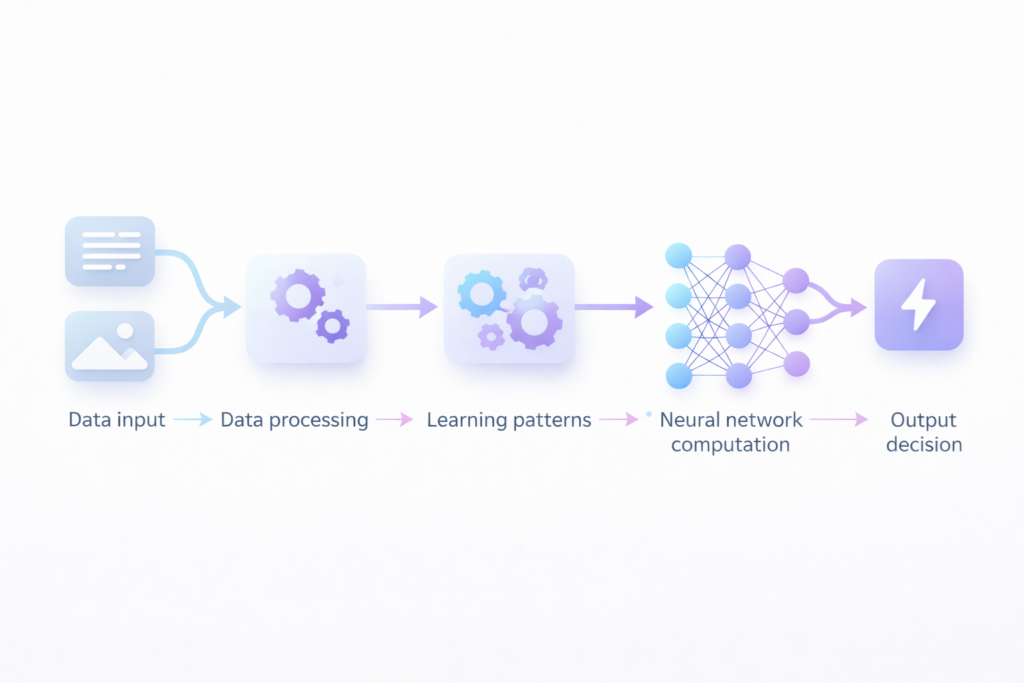
Artificial intelligence is not a single machine or algorithm. It’s a combination of data science, computer architecture, and mathematics. It takes raw data such as images, videos, and text, converts it into numbers, finds patterns in those numbers, understands the data, makes predictions based on those patterns, and gives us an output. So, in today’s article, we will learn how AI works and specifically how does artificial intelligence work and how AI is trained.
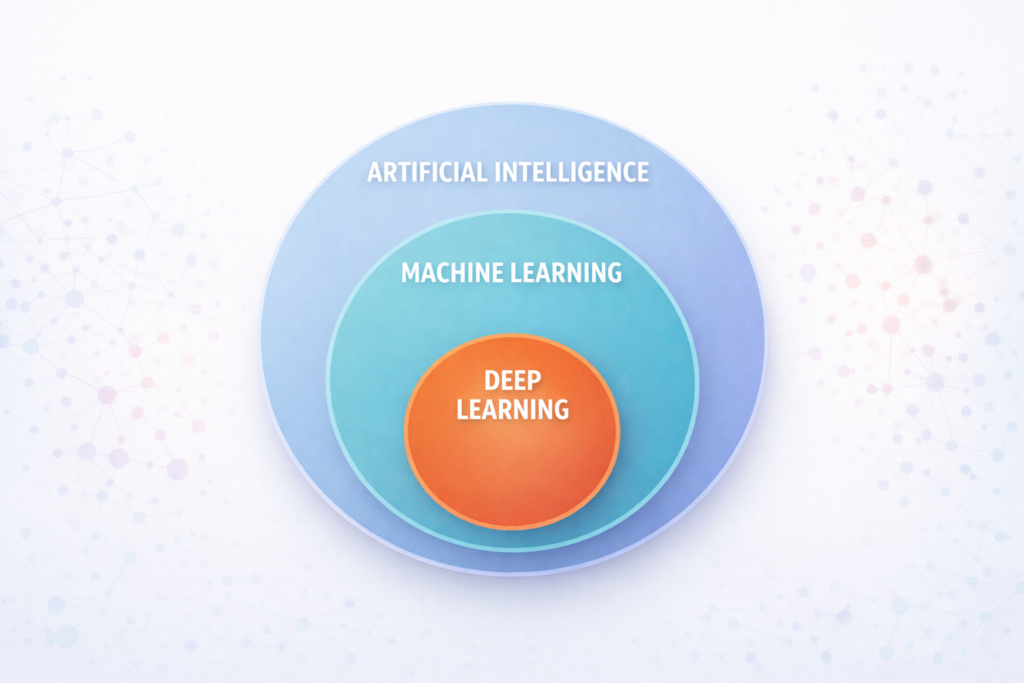
The relationship between Artificial Intelligence, Machine Learning, and Deep Learning.
Artificial Intelligence
Artificial intelligence is not a single concept. It’s a broad concept whose main goal is to enable machines to think, understand, and make decisions.
machine learning
Machine learning is a part of artificial intelligence where machines are taught and trained using data. In this approach, the machine is trained on data rather than being given explicit rules.
Deep learning
Deep learning is an advanced form of machine learning: in this approach, the machine automatically understands more complex data such as images and language.
How does artificial intelligence learn? (Methods)
There are 3 ways to train artificial intelligence.
1. Supervised Learning
- In this learning, answers are also given to Artificial Intelligence along with data.
- Example: spam vs not spam emails
- Example: dogs vs cat photos
- This learning method offers high accuracy, but it is also costly.
2. Unsupervised Learning
- In this type of learning, artificial intelligence is given unlabeled data, and it finds patterns within that data.
- Example: Customer segmentation, clustering
3. Reinforcement Learning
- He learns through reward and punishment.
- Example: Games, robotics, self-driving systems
Neural network (the brain of AI)
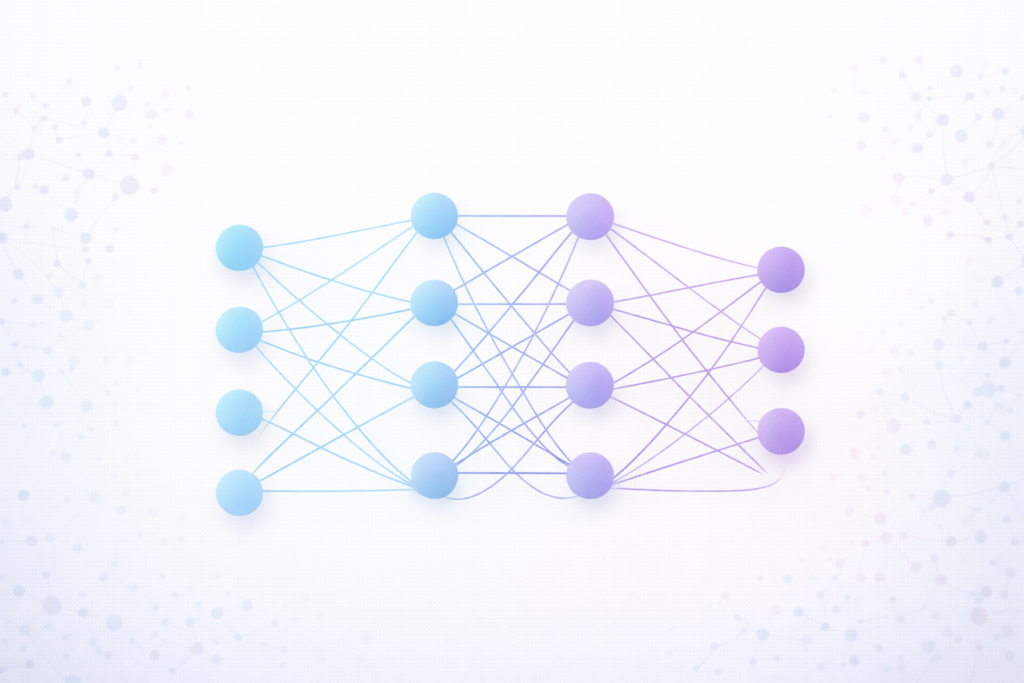
The core structure of AI is the Artificial Neural Network (ANN)
- Neuron: A small computational unit
- Weights: Indicate how important each input is
- Bias: The minimum activation value
- Activation Function: Helps in making decisions (ReLU, Sigmoid)
A neural network has 3 layers
- Input Layer
- Hidden Layers (where the real processing happens)
- Output Layer (the final result)
How does artificial intelligence learn?
Artificial Intelligence’s learning process keeps repeating
- Forward Propagation – The model makes a prediction.
- Loss Function – The error in the prediction is measured.
- Backpropagation – The reason for the error is propagated backward through the network.
- Gradient Descent – The weights are adjusted to reduce the error.
This cycle continues until the errors are minimized.
Generative AI & Large Language Models (LLMs)
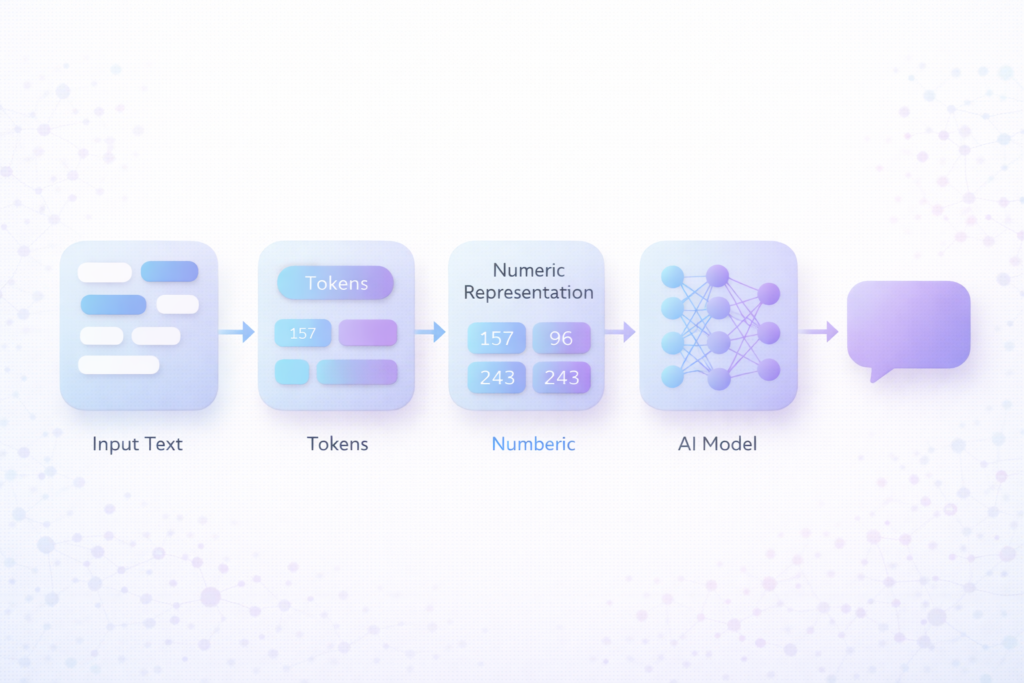
Large Language Models (LLMs) like ChatGPT, Gemini, or Claude are trained on self-supervised learning.
This means that no human manually labeled the answers to train the LLM. The model creates its own questions and answers – from text data.
LLMs use the Transformer architecture, in which
- The attention mechanism helps in understanding the context.
- The model predicts the next word at each step.
This is why AI sometimes gives confident but incorrect answers(Hallucinations).
AI Hardware – Power Behind AI
- CPU: Serial work (slow for AI)
- GPU: Parallel processing (best for AI)
- TPU / LPU: Special AI chips (for matrix calculations)
They need speed, so GPUs and AI chips are used.
Real Challenges of artificial intelligence
- Training is expensive.
- Bias can creep in from the data.
- Hallucinations are possible.
- It doesn’t “remember” facts, it only calculates probabilities.
Conclusion: It’s not magic, it’s engineering.
After understanding Artificial Intelligence, and especially Large Language Models (LLMs), one thing becomes clear—AI is not a magical thinking machine. It is a highly-engineered system based on mathematics, probability, data, and computing power.
If you want to understand what is artificial intelligence, you can read our detailed guide here.https://right2tech.tech/what-is-artificial-intelligence/
One thought on “How Does Artificial Intelligence Work? (A Simple Step-by-Step Explanation)”